

Maranatha’s Internship Program: Developing Career Skills, Resumes, and Passion
If you want to get a good job when you graduate from college, you need to know an important fact: many employers want to see an internship on your resume. In fact, studies show that employers don’t care that much about your grade point average or even your major. It’s your internship that counts.
And that’s one reason that Maranatha’s internship opportunities are growing by leaps and bounds.
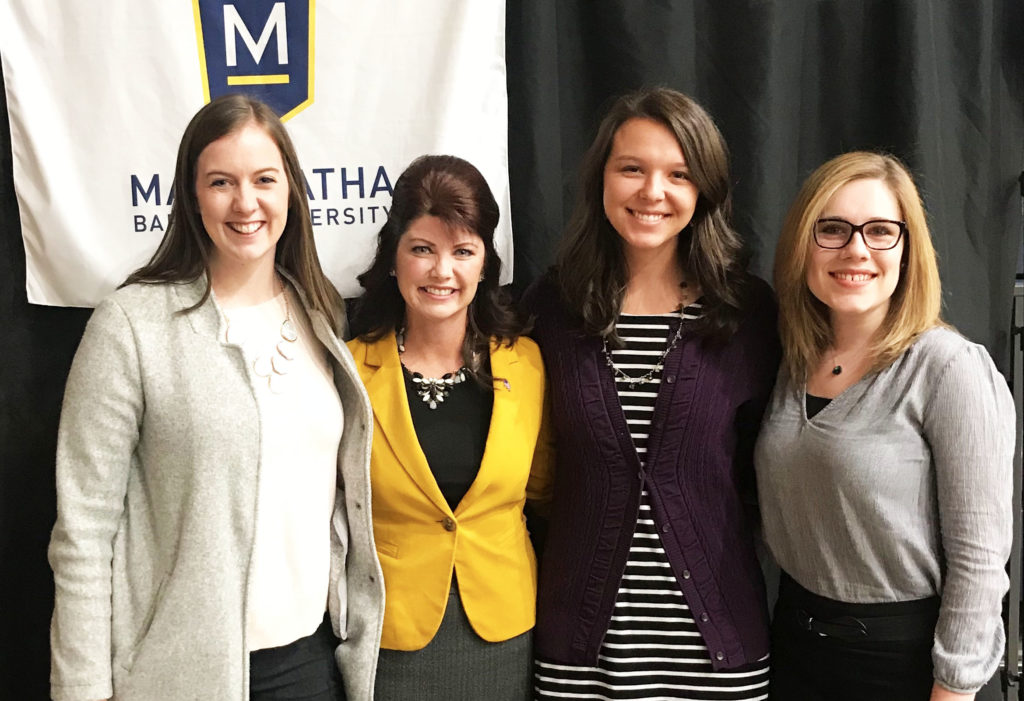
In the last year, two Maranatha students had a fantastic opportunity to develop their skills and their resumes. These two students, Sydney Luttrull and Margaret McMenamin, worked at the office of Wisconsin’s former Lieutenant Governor, Rebecca Kleefisch, while she was in office.
Sydney (pictured above – second to the right) is an English major and Piano Pedagogy minor from Lewistown, Missouri. She chose Maranatha because she wanted a strong academic and strong Christian environment. And as an athlete who is also gifted musically, she was attracted to Maranatha’s sports and fine arts programs.
Margaret (pictured above – right) is an English major and Business Management Minor from Philadelphia. She came to Maranatha because of its strong academics and its spiritual atmosphere, but also because the campus felt like a family. “I liked the idea of going to a college with smaller classes because it feels more personal,” she says.
Recently, Sydney and Margaret answered some questions about their internships.
As you worked with the Lieutenant Governor, what were you doing?
Sydney: I answered calls, helped with office tasks, and wrote letters to constituents and businesses. But most of all, I researched organizations and companies the Lieutenant Governor was going to visit, creating summaries for her itinerary. I also participated in her meetings and traveled with her and her staff to events. I was working on a different project almost every day.
Margaret: My main responsibility was to write briefs for the Lieutenant Governor. Every week, I would research the events for the coming week and assemble them in a binder. She reviewed this binder over the weekend and as she traveled to events. These briefings are vital for her because they include information on prominent individuals at the event and other information on the event, such as media coverage and the number of people that would be there.
Tell us about a memorable day of your internship.
Sydney: One day I traveled with the Lieutenant Governor to two farms. Since I was born and raised on a farm, the struggles that these farmers were facing, both economically and politically, hit close to home. That day, I recognized the huge need for agricultural representatives in government that understand the farmer’s life first hand, and I recognized that I could fill that void.
Margaret: One day I was able to go with the Lieutenant Governor to a groundbreaking in Madison. While she was speaking, I took pictures for office records and social media. It was awesome to be there because I created the brief that she based her speech on, and she incorporated many things I wrote in her speech. It was also special because I was asked to sign the memento groundbreaking shovel right next to the Lieutenant Governor’s signature.
How has this internship helped you prepare for your career?
Sydney: It gave me a burning desire to serve. I don’t want to work at a capitol for the rest of my life, but at some point I would like to run for office, bringing my ideas to the table, and serving for an appropriate time.
Margaret: It helped me realize that even in my career, people are the highest priority. The Lieutenant Governor taught me so much about how to interact with people by her example. She always remembered names, she tried to relate to everyone on a personal level, and she was careful to remind everyone that she was just an average person trying to help people the best way she could. Often, she would get so busy talking with people that her staff would have to pull her away so she wouldn’t be late for the next event.
How did you grow spiritually during this internship?
Sydney: I learned that our faith will be observed and tested in the mundane aspects of the job. Your coworkers don’t care about the finer points of your faith or how it affects your political views. Instead, they care about why you work hard, why you treat even insignificant tasks with importance, why you treat everyone with respect (even when they disagree with you), and why you hold yourself to a higher standard of work and action.
Our faith affects those things, and people notice. The brightest lights in the workplace are the people who perform every task with consistent excellence as if they are working for God himself.
Margaret: I learned that I need to depend on the Lord. When I was first approached about this internship, I thought, “Absolutely not! I couldn’t do anything like that.” But I have a God who can do abundantly more than I can. So I learned to depend on the Lord for everything. When I felt intimidated by the brilliant people I was surrounded by, I had to depend on the Lord for confidence and wisdom. When I felt overwhelmed, I learned to depend on the Lord for strength and a clear mind.
Did your education at Maranatha help to prepare you for this internship?
Sydney: Definitely. I have not only learned how to communicate clearly in writing and in speech, but I have learned how to think critically in any situation, and this is a skill that is underdeveloped in many interns.
Margaret: Absolutely. Since coming to Maranatha, I have been pushed outside my comfort zone. I was taught to look at challenges as opportunities to grow. Academically, I developed writing skills that I used every day when I wrote letters or briefs. I was also taught how to think critically, which was vital in creating briefs and deciding what was important and what wasn’t. Even my Bible classes helped prepare me by teaching me creative ways to witness and by expanding my knowledge of God’s word.
Honestly, the teachers at Maranatha have made the greatest impact on my education. They consistently go above and beyond what is required of them to help me be the best student I can be and, more importantly, the best person I can be. Mr. Board encouraged me to apply, helped me connect with the right people, and got me the information I needed.
The faculty also helped me with so many details. Since I had never written a resume before, Dr. Miller and I created one together in his office. Mr. Zwolanek wrote my recommendation letter, and other teachers offered to write one whenever I need it. Mr. Kolwinska and Mr. Huffstutler frequently met with me to discuss my work and to give me hope when I felt like I was drowning. And Dr. Drost taught me servant leadership through his classes and his example.
Overall, how do you feel that this internship has prepared you for your future?
Sydney: It has given me great connections in the political world, a better understanding of what it takes to be a politician, and a realization of the support I will need to be successful.
Margaret: I learned that experience is vital—you don’t know what you want to do till you try it. Overall, I grew more confident, became a better professional, and developed important connections. Also, I left with a significant addition to my resume that has already helped me get into another awesome program (the Alliance Defending Freedom).
Most importantly, I developed strong relationships with all the individuals I had the privilege to work with. By the end of my internship, they had offered to help with everything from writing recommendation letters to helping me find employment after graduation.